ABOUT ME
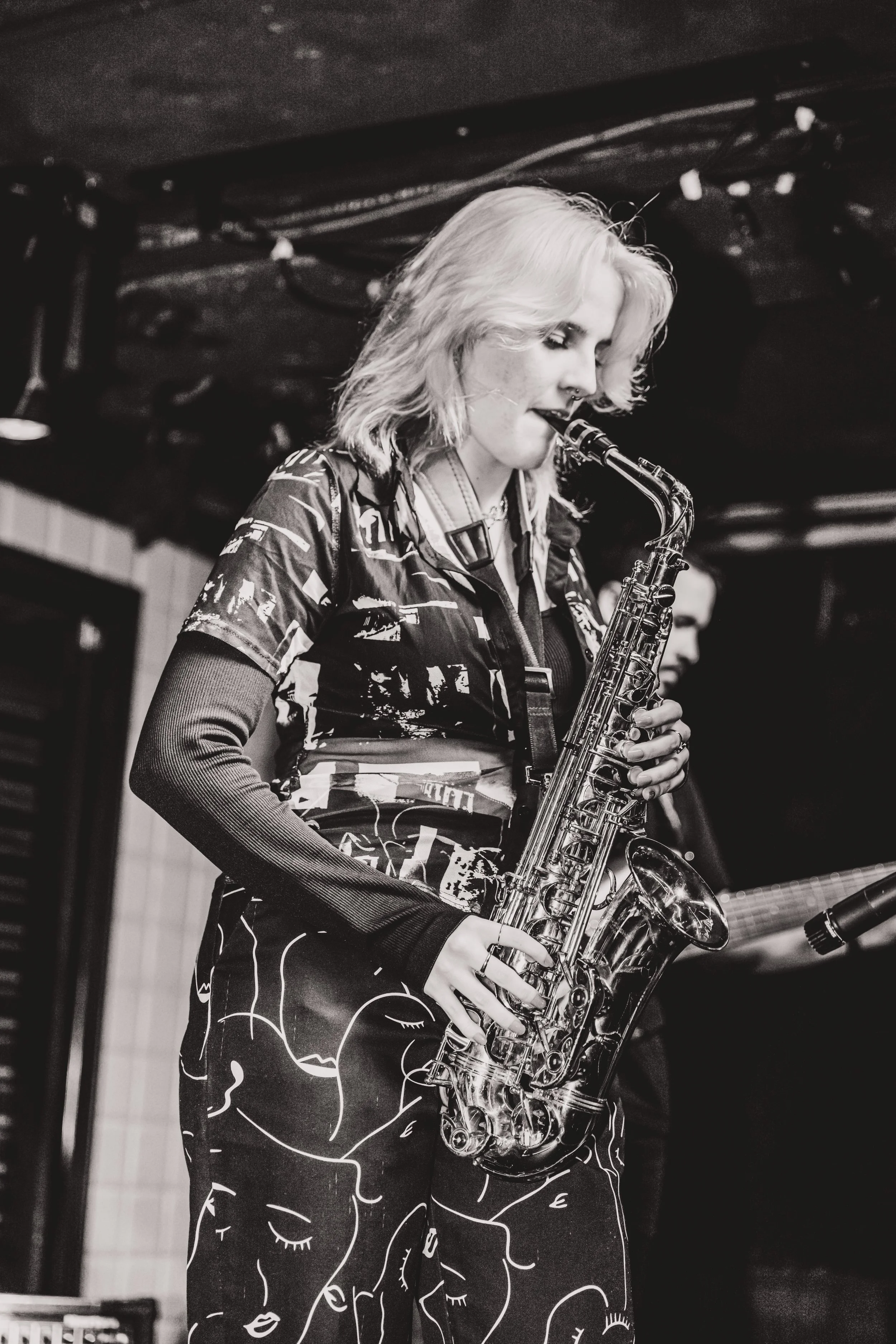
Jasmine Good (she/her) is an Australian composer, performer and educator whose work was awarded Gold at the 2026 Mozart International Music Competition for BLOOD WATER. She believes music should reflect rather than instruct. Rather than communicating a fixed message, her compositions are designed to evolve through interpretation, becoming shaped by the performers who bring them to life and the audiences who encounter them.
Working across concert music, choral repertoire, wind ensemble and musical theatre, Jasmine creates works that resist definitive interpretation. Guided by mathematical systems, geometry and pattern, she uses compositional constraint as a catalyst for invention, allowing unexpected musical ideas to emerge within carefully constructed frameworks.
Winner of MUSE's 2024 annual search for new works, her original musical THE FUTILITY OF FALLING premiered at Sydney's Flight Path Theatre. Whether writing for professional ensembles or community musicians, Jasmine composes works that continue to grow long after the final note has been written.
ARTIST STATEMENT
My compositional practice explores the tension between control and openness: the space between a work’s internal design and the meanings it develops beyond the score.
I am drawn to the question of how carefully constructed systems can create music that remains unpredictable, personal and open to interpretation. Rather than presenting a singular narrative, my work creates frameworks through which multiple interpretations can coexist. A composition may begin with a specific concept, but its meaning is not confined to the circumstances that inspired it. Performers bring their own understanding to the score, and audiences encounter the work through their own perspectives. Interpretation is not a by-product of the composition; it is part of what gives the work its identity.
A central aspect of my process is the use of mathematical systems, geometry and pattern as tools. I often begin with abstract relationships, numerical structures or visual forms and translate these into musical material. These systems act as creative provocations, introducing limitations that force musical ideas to move beyond instinctive solutions. Within constraints, unexpected relationships emerge, revealing possibilities that may not have existed without the framework. This balance between precision and discovery is fundamental to my writing. Mathematical processes provide a structural foundation, but they do not determine the final meaning of the work. Instead, they create an environment where complexity, ambiguity and musical expression can develop. I am fascinated by the moment when a predetermined system gives rise to outcomes that feel intuitive, organic and human.
My experience as a performer informs my understanding of the relationship between score and sound. As a singer and multi-instrumentalist specialising in saxophone and clarinet, I have spent years engaging with music from the performer’s perspective. This experience shapes the way I write for musicians, allowing me to approach notation not simply as instruction, but as a form of communication between composer and performer.
Across concert music, choral repertoire, wind ensemble, chamber music and musical theatre, my work seeks to balance conceptual rigour with accessibility. I am drawn to creating music that can hold complexity without requiring a single interpretation, allowing performers and audiences to engage with the work on their own terms.
The score is not the end of the composition, but the moment it enters the world. I compose reflections rather than instructions, creating works that evolve through those who perform and encounter them.